News
- 2026/09/27 - The ODIN 2026 Workshop Has Concluded — Thank You!
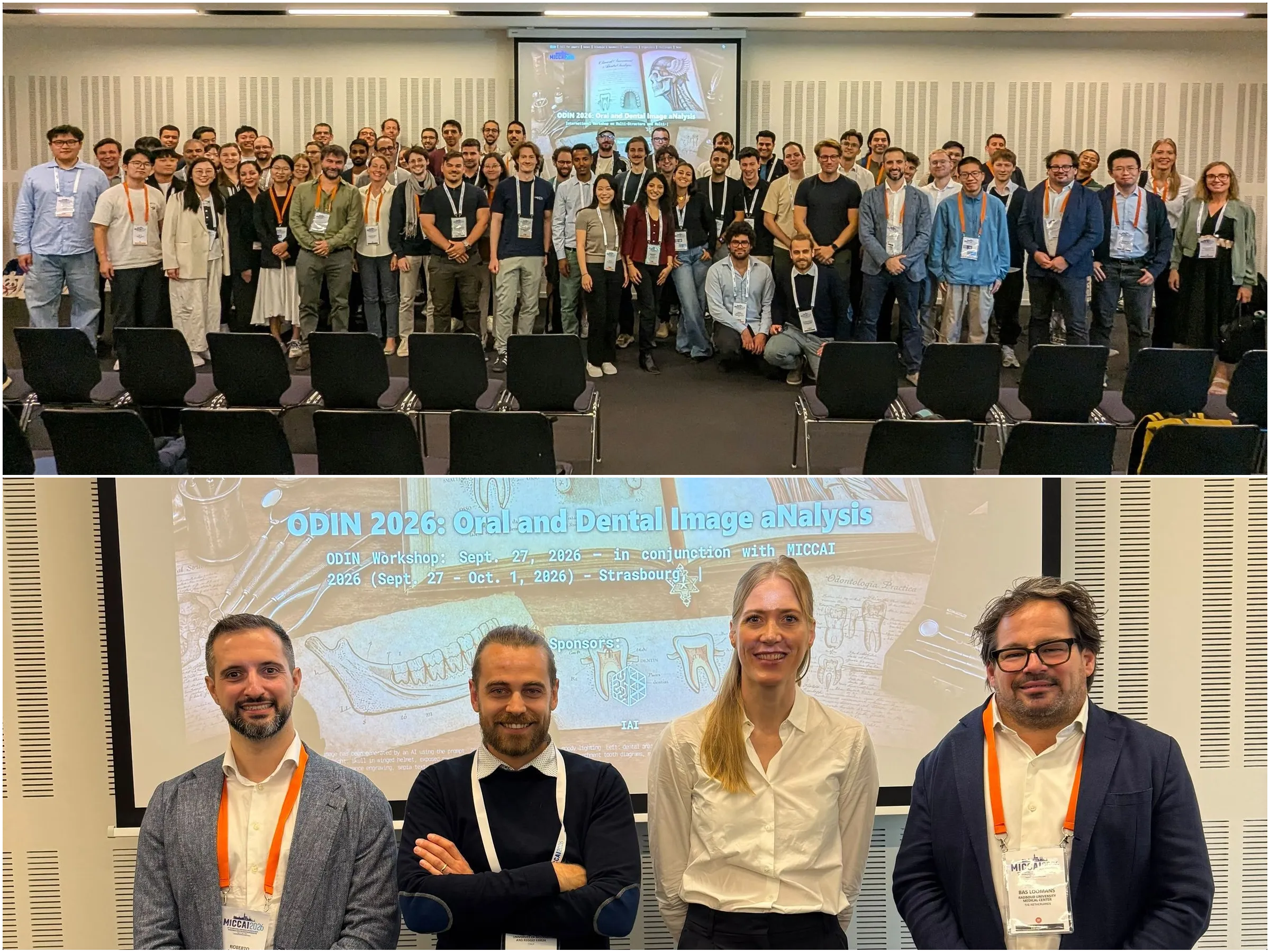
The second edition of ODIN — Oral and Dental Image aNalysis — has come to a close at MICCAI 2026 in Strasbourg. We want to thank everyone who made this workshop possible: the participants who filled the room and engaged with every talk and poster, the invited speakers Bas Loomans, Roberto Mangano, and Tabea Flügge for their outstanding keynotes, all the authors who presented posters and spotlight talks, the ToothFairy4, Bite2Text, and STS challenge teams for their submissions and hard work, and the organizers and program committee who worked behind the scenes for months to bring this event together. See you at the next edition of ODIN!
- 2026/09/27 - ODIN 2026 Challenge Results Online: Top-3 Revealed at MICCAI 2026!
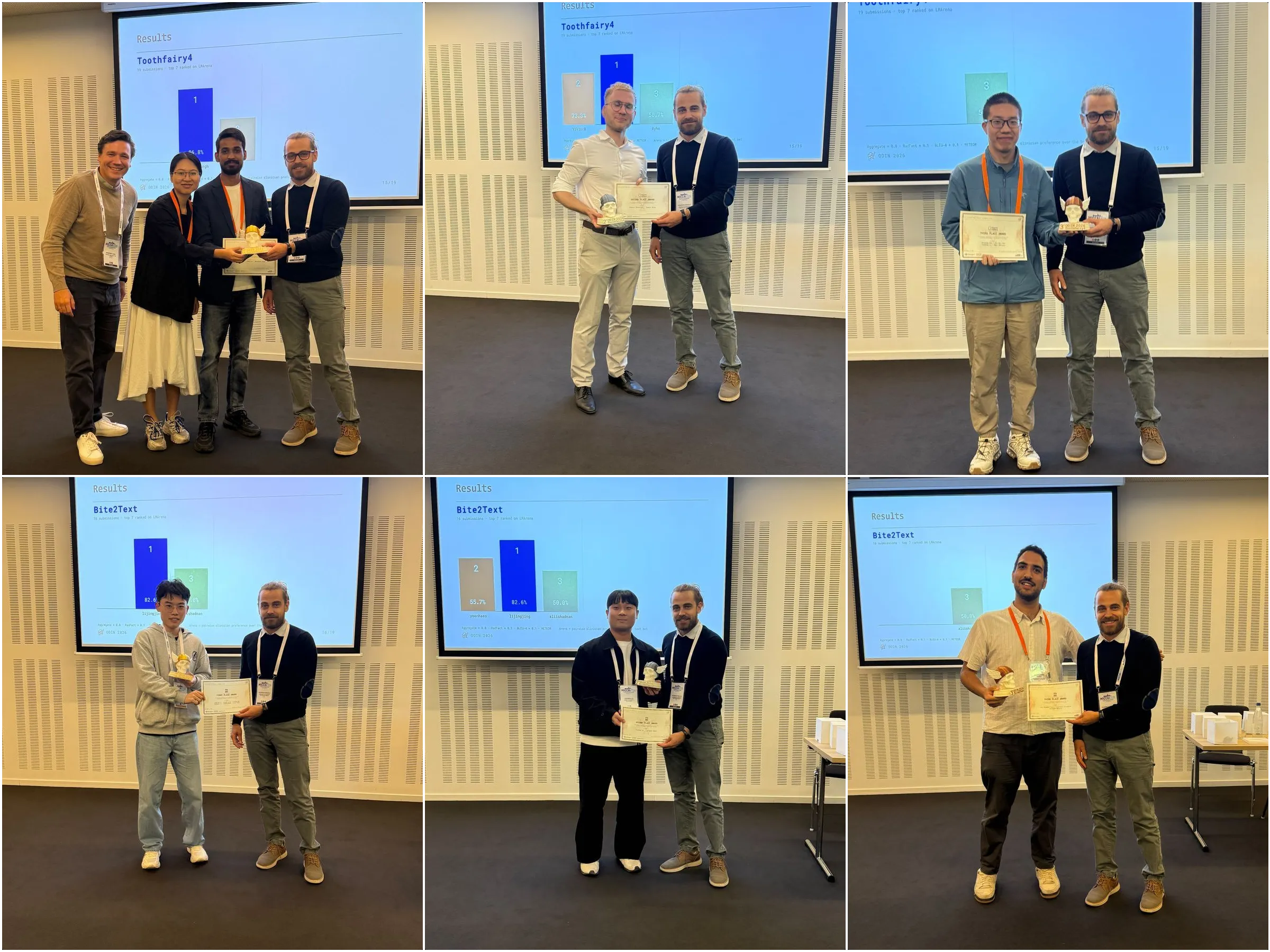
The final results of the ToothFairy4 and Bite2Text challenges are published on the Grand Challenge winners page, and the top-3 of each task has been revealed live today during the ODIN Workshop at MICCAI 2026. For each task, the page shows the complete final leaderboard (RadFact, BLEU-4, METEOR, and the aggregate score for every team), plus the Arena win rate and Elo score of the finalists who advanced to the expert evaluation. The slides of the winners’ presentations are available on the schedule page.
- 2026/09/27 - ODIN 2026 Is Taking Place Today!
The ODIN 2026 Workshop is happening today at the Strasbourg Convention Center, France, in room Londrezs 2 (G), starting at 8:00 with the opening remarks. The program features invited keynotes by Bas Loomans, Roberto Mangano, and Tabea Flügge, spotlight and poster sessions, and the ToothFairy4, Bite2Text, and STS challenge sessions in the afternoon. See the schedule page for the full program and the invited speakers. See you there!
- 2026/08/05 - Paper Submission Deadline Extended
The submission deadline for the challenge papers has been extended to 7 August 2026. Please see the dates page for more details. No additional deadline extension will be announced.
- 2026/07/01 - ToothFairy4 and Bite2Text Registration and Debug Submissions Open
Registration and submissions for the debugging phase of ToothFairy4 and Bite2Text are now open until 17 August 2026. Visit the challenges page to learn more about the tracks and participation details.
- 2026/06/29 - Extended Paper Submission Deadline for Workshop Papers
The paper submission deadline for workshop papers has been extended to 13 July 2026. Please see the dates page for more details.
- 2026/06/18 - Bite2Text Challenge Paper Accepted at ECCV 2026
Proud to announce that the paper describing the Bite2Text data has been accepted for publication at ECCV 2026. Paper, source code, and any other material will be released very soon!
- 2026/06/12 - ToothFairy4 Challenge Paper Accepted at MICCAI 2026
The paper describing the data used by the ToothFairy4 challenge has been accepted for publication at MICCAI 2026, main track. In addition to presenting the dataset, the paper defines an ontology for CBCT maxillofacial data and models report generation as a three-stage structured prediction problem, providing a first strong baseline and introducing corresponding metrics. Check out the paper for more details.
- 2026/04/19 - MICCAI 2026 Location Update: Strasbourg, France
Given the ongoing uncertainty in the Middle East, the MICCAI Chairs announced that the 2026 conference location has been changed to Strasbourg, France, with updated dates of September 27 to October 1, 2026. Please read the official news announcement for more details. We look forward to seeing the community in Strasbourg this fall!
- 2026/03/16 - ODIN2026 Challenges Accepted at MICCAI 2026
We are excited to announce that all ODIN2026 challenges have been officially accepted at MICCAI 2026! The challenge program includes two tracks from the ODIN series — ToothFairy4 and Bite3Text — as well as the STS challenge. More details about each challenge are available on the challenges page, and key submission dates can be found on the dates page.
- 2026/02/09 - ODIN2026 Workshop Accepted at MICCAI 2026
We are pleased to confirm that the ODIN2026 workshop proposal has been officially accepted at MICCAI 2026! The community is invited to submit their work — see the call for papers for topics and guidelines, or consult the submission instructions for details on the paper format and submission process.
- 2026/01/15 - ODIN2026 Workshop Proposal Submitted to MICCAI 2026
Waiting for final confirmation, we’ve already put together a strong lineup of invited speakers—stay tuned for updates.
- 2026/01/09 - ODIN2026 Challenge Series submitted for evaluation to MICCAI 2026
We are pleased to announce that the ODIN2026 Challenges proposal has been submitted to MICCAI 2026 and is currently under review. ODIN2026 introduces a new benchmark for multimodal clinical report generation in oral and dental imaging, moving beyond segmentation and landmarking toward end-to-end 2D/3D-to-text systems that produce structured, clinically meaningful descriptions. The challenge features two complementary tracks: ToothFairy4, focused on generating maxillofacial and surgical planning reports from CBCT volumes, and Bite2Text, focused on orthodontic report generation from intraoral scans (IOS) with optional intraoral photographs. Both tracks emphasize robust generalization, leveraging multi-center training data and a fully hidden test set from an independent center, with evaluation combining automatic report-generation metrics and clinician-oriented assessment.